Monday, 20 June 2016

Back to Spain on Europe Day

Even though Boris was able to change his deeply-held views on EU membership over a single weekend, Bonzo has taken a lot longer to make up his mind; mainly, because he thinks that "Brexit" is a new brand of dog biscuit.

Come what may, after voting Bonzo will  go back on guard duty at our home in Essex while Jean and I head back out to Muxia to apologise to the Spanish and hopefully do a little sailing.

Image result for spain

Spain

We are very grateful to the Spanish Nation not only for making us welcome in their lovely country and looking after our boat when we are away, but also (amongst a lot of other things) for staffing the NHS and even providing various members of our family with au pairs.

By the way, "I'm in".

Our plans for the trip.

24th June  ("Europe Day"):  back to Europe (Spain actually) via Santiago de Compostela, then bus to Muxia.  Assuming the boat is still floating we look forward to a restful night in the marina.

Eventually (having  re-provisioned and found our courage and sea legs) we will head South. Leaving the Costa da Morte and heading out and around  Cape Finisterre, thence to another peaceful anchorage somewhere.

Angela is joining us on 27th June, perhaps in Muros. Al will be with us  (for another epic adventure) from 13th July.


Sunday, 10 April 2016

Coruna to Muxia


Eventually, just before it was time to go home, it stopped raining and the wind dropped.  This meant that we had very little excuse for not going sailing.

We decided to go sailing.

Our aim had always been to "get around the corner" so we decided to head west to the next "easy" Ria.  This was about 48 miles away and is called " Ria de Camarinas".  So we went.


The entrance to Ria de Camarinas from the south.  America would be to the left. We came from the north.

This Ria has two marinas.  
At the last moment (in order to add excitement) we decided to go for Marina Muxia.


From the top of the hill, Marina Muxia left, Atlantic Ocean right.

 Marina Muxia is friendly, easy , pleasant  and in March pretty much empty.  The marina team operate out of the petrol station that overlooks the ramp to the pontoons.  Call on VHF 9.  He took our ropes and spoke english.


There is a nice walk to the top of the hill and a good view.

Muxia is a town of Religious Significance.

Long ago, The Virgin Mary  came to Muxia in a stone boat (presumably via the Straits of Gibralta and the Portuguese Coast) in order to give support to  St James the Apostle who was doing great things in Santiago De Compostella (which is only about 40 miles inland).

This story, the veracity of which is obviously not in doubt (although stone boat manufacture doesn't appear to have stood the test of time), has resulted in a successful tourist trade for Muxia.

The tourist trade is presumably the justification for the massive and beautiful stone monolith that has been erected near to the church that commemorates Mary's visit.

Unfortunately (according to local legend) the "monolith"  was found  during its erection process to have significant structural weaknesses.

Monolith or what?


We like Muxia and have left the boat there while we return home for a couple of months.

Berthed in Muxia Marina.

Tuesday, 29 March 2016

Rain in Spain

Even in Roman times scholars struggled to explain the Easter climate of Coruna.
Was it the location, the altantic breeze, the unique political allegiances of the region (and its role within the EU), or it just bad luck?   Is it something to do with the meaning of the word "Coruna" in pre-roman Gaelic?

Anyway it rains a lot in Coruna at Easter.

Not perturbed, our dynamic trio  set about out - smarting the conditions by out sleeping  them.  Our daily routine now involves, thinking about getting up, getting up, having breakfast, checking the weather, lunch, siesta, supper and bed.

We have also managed a mighty voyage from Marina Seca to Marina Coruna  (nearly 2 miles) and look forward to a trip out into the Atlantic to Muros at the weekend.

If it stops raining ......


On Easter Day, when it stopped raining, there was a procession:


An Easter Day Procession in Coruna

Wednesday, 4 November 2015

The importance of Bird Tables

The Modern Garden Bird, especially if residing in the Home Counties, prefers to feed from a good quality and well-appointed bird table.  

The days when “anything with plenty of nuts on it” was satisfactory are long gone. 

The Modern Bird now demands Modern Standards.  

Thus, a wonky table, poorly constructed with a curling roof (as in the example below) not only lacks the aesthetics demanded by the Modern Bird but is also frankly, unseaworthy.


 An unsatisfactory bird table.

The answer of course is to construct a Modern Stylish Bird Table. Such tables, built from only the finest marine materials, will give your Garden Birds years of pleasure unless of course something nasty befalls them in the meantime.

Technical tip.  If after construction, your new table looks like this:

(Bad)

it will be good practice to turn it over, thus:

(Good)

An upside-down table is not only difficult to erect but may also lead to disapproval, confusion, even consternation amongst visiting feathered wildlife.

The Modern Bird will of course appreciate the style and design as well as the build quality of his or her new table.  More and more garden birds prefer their table to have something of an Austrian Tyrol look, being aware, as many now are, that good snow-sheltering qualities add safety and comfort for the winter forager.

Fully erected, our new table has the added benefits of a squirrel-proof stand and four-layer yacht varnish finish.


"The Essex". A Tyrolean style bird table recently erected somewhere in the Home Counties.

Sunday, 11 October 2015

Something about Boxes for Barn Owls

If, Dear Reader(s),  you ever come to that extraordinary stage in life when your garden really doesn't need any more sheds, you might consider building and erecting a Barn Owl box.  Such a project demands not only the carpentry skills of the experienced shed builder but also many of the rigging skills of  the aging yachtsman.

Like all of us, Barn Owls need a place to call "home".


An Owl (possibly without a home)


Barn Owls  normally enjoy nesting in barns. Such barns need to be sufficiently decrepit or run-down to be accessible to the homeless owl.  In Sussex barns tend, of course, to be either modern and well-maintained and therefore generally unwelcoming for owls, or to have been converted into houses and therefore generally already inhabited by people.


A Barn

A good big tree with a good big and snug hole in it is a satisfactory alternative for the owl (especially as such trees make very poor barn conversions) however, these are few and far between and often beyond the means of the young Barn Owl setting out to start a family.

In short, Dear Reader(s), Barn Owls need Boxes.

The Highly Desirable Barn Owl box will have many of the following features:
Location .. location ... location ...  (it will be a in a sought after neighbourhood, facing north or east with an open aspect across fields and far away from busy roads).
The box should be up a tree, at least 3 metres above the ground.
It should be warm and dry inside with a non-slip, self-draining, veranda near the main entrance from which  young owls may practice their flying skills.  The veranda should  obviously (for Health and Safety reasons) be surrounded by a small fence  so that young owls don't fall off.
I could go on.


A Highly Desirable Owl Box (note veranda)

Our Owl Box comes with two important sets of instructions, as follows:

Instructions for cleaning:
"When absolutely certain that the house is Absolutely Vacant of Nesting Owls, remove the the lower panel by undoing the two nuts and prizing it forwards evenly (a few mm at a time) using a flat screwdriver or suitable blunt blade.   Crap, dead animals and other excess detritus may then be removed, taking great care not to fall off the tree, fall off the ladder, stab yourself with the screwdriver (and then fall off the ladder), drop the nuts or inhale, ingest or otherwise absorb any poisons, germs, bacteria or fungae contained within the owl box.
Replace the panel."


The removable panel with instructions to avoid confusion


Instructions to owl:
"We hope you will enjoy your stay in your new home.
If you have any queries, complaints or suggestions please don't hesitate to contact The New England Wood Trust Owl and Arboreal Dwellings Department at the address below.
After you have made yourself at home please take the following steps to preserve your species:
1. Find a mate.
2. Entice your mate back home (perhaps suggest coming inside "for a coffee").
3. Copulate.
4. Lay your eggs (indoors).
5. Keep your eggs warm by sitting on them.
6. Feed the resulting chicks diligently.
7. Teach them to fly and insist that they embark on an independent life.
8. Repeat yearly or until your new home falls off the tree."

Having built your box, it will need to be, in technical terms "stuck up a tree".

To do this, first, recruit some friends and find a big wheel barrow.


Friend, owl box and wheelbarrow.

Next, set off across the fields.


Across the fields

Stick the owl box up a tree using traditional maritime technology.


Up a tree

Make sure it is straight and level.
Your tenant owl may be unhappy if her eggs roll around inside her new home.


Is it absolutely straight?

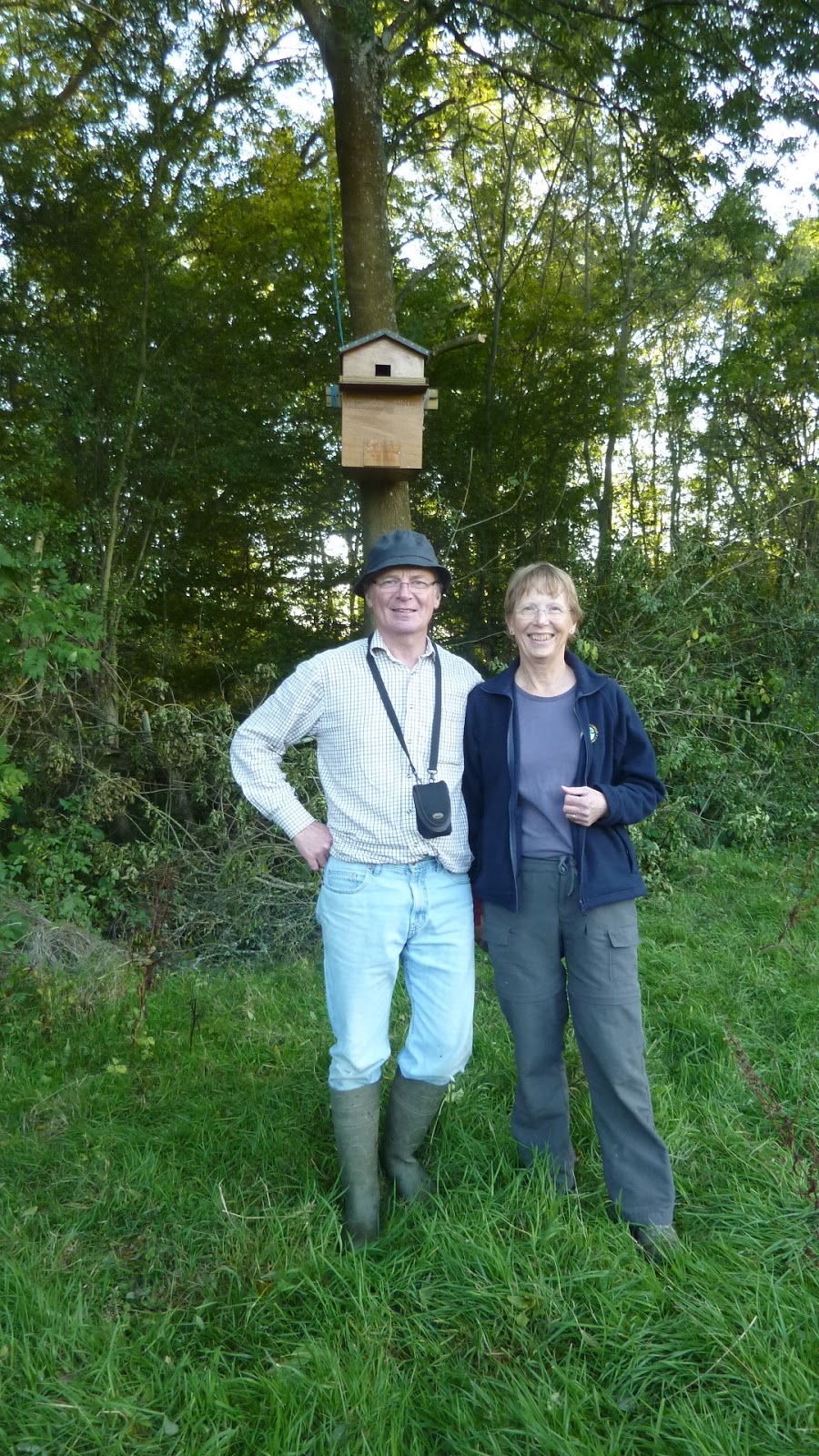
Stand back and admire and arrange appropriate photographs.


Posing with owl box

Ready for tenants


The New England Wood Trust Owl box awaiting occupation.


Sunday, 27 September 2015

Coruna

Coruna, La Coruna and A Coruna are all, in fact, the same place.

Coruna used to be spelt "Corunna".
Importantly, the   n  has a squiggle over it.  This adds authenticity and is regarded as a good thing (if you can find how to do it on your computer).

Coruna is in Spain but on 16 January 1809 the French and British had a nasty battle there.
The British, having been chased northwards through Spain (by the French) arrived in Coruna expecting to catch a ferry back to Blighty. The ferry was late and Sir John Moore was killed but the French were repulsed until the ferry arrived.

Presumably in order to prevent similar catastrophes in the future, a big modern marina was built in Coruna a few year ago, and this is where we now find ourselves.

Marina Coruna is excellent apart from its tumble drier..
The staff however, are extremely excellent and also speak English.


Marina Coruna

After an extended stay in UK we returned to our Albatross in Coruna Marina.
Next day we motored over to Marina Seca.

Marina Seca is run by the same excellent people as Marina Coruna but it also has a boat lift and hard-standing. There is unfortunately no tumble drier at Marina Seca.


Albatross ashore

Albatross will winter  in Marina Seca and we hope to see her again in March or April.

We hope to welcome many of  our friends aboard again next year for exciting voyages along the Atlantic coasts and Rias of Spain and Portugal.

Tuesday, 4 August 2015

2015 .. the plot so far

The voyage of "Albatross" 2015 (Troon to Coruna)